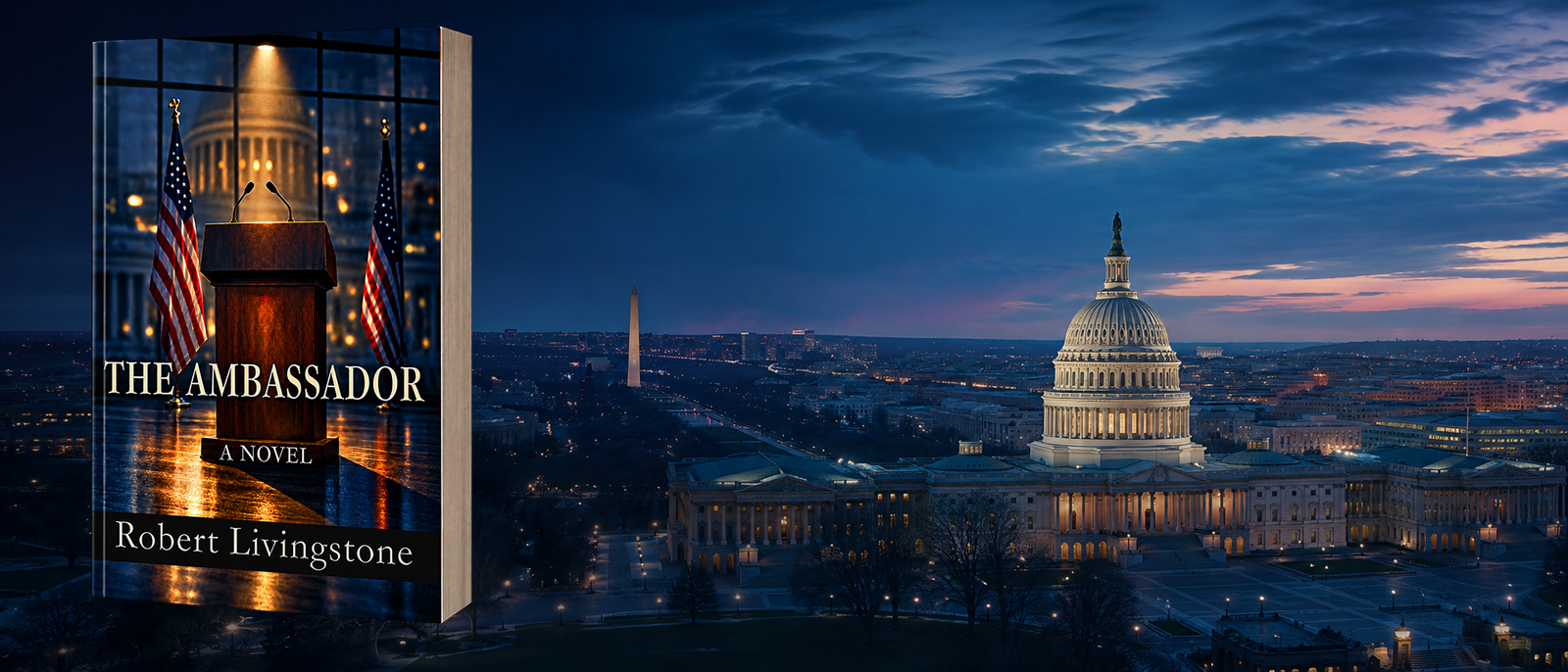
THE AMBASSADOR
Catherine Cortez, a prominent television journalist, is drawn into a political crisis that quickly becomes far more dangerous—and far more personal—than she expects.
As Washington erupts around a struggle involving diplomacy, presidential politics, ambition, and betrayal, Catherine finds herself moving ever closer to the center of events. What begins as a story to be reported becomes a test of judgment, loyalty, and courage, with consequences that could reach all the way to the White House.
Powerful figures maneuver behind the scenes. Alliances shift. Motives are concealed. And Catherine must determine whom she can trust as the stakes continue to rise.
The Ambassador is a fast-moving political thriller about power, influence, personal conviction, and the decisions that can alter the course of a presidency.
Praise For The Ambassador
“The Ambassador is a fast-moving political thriller filled with intrigue, deception, and suspense. Catherine Cortez is a strong and engaging main character, and the story is thought-provoking as well as entertaining.”
— Patrick Kelly
“Exciting, suspenseful, and full of unexpected twists. The political intrigue and behind-the-scenes power struggles made the story especially interesting.”
— Ann Reilly
READ AN EXCERPT
Chapter 1
The glass doors opened with a soft hydraulic sigh and Catherine Cortez stepped through without breaking stride. The lobby beyond was designed to impress. Black marble floors, brass trim, recessed lighting that never quite reached the walls. Everything polished. Everything controlled. It felt expensive in a way that wasn’t meant to be admired so much as understood. Deliberate.
She noticed the silence first. Not the absence of sound—there were footsteps somewhere, voices carried faintly across the space—but the way it was managed, contained, like a studio just seconds before a broadcast. Ahead of her, the ITS logo caught the light, etched in silver and backfilled in blue, set into the marble like a seal. Authority without explanation.
To the left, a single framed image hung in perfect isolation. A woman half-turned toward the camera, strong jawline, calm eyes. The kind of face that didn’t ask for attention but received it anyway. Cortez. Her own face, ten years younger. Beneath her name, the tagline: The News that Matters.
She kept walking. Just enough time for makeup.
Inside the studio, the air shifted. Cooler, cleaner, engineered. Lights hung overhead in quiet grids, casting a controlled brilliance over a set built of glass and metal, minimal and exact. Catherine, fresh from Hair & Makeup, moved to her position beneath the cameras and stopped, adjusting nothing. She didn’t need to.
She was in her late thirties, but the camera read her younger. High cheekbones. Clear olive-toned skin. Long, dark hair coiled into a tight twist. Not a strand out of place. Her makeup was broadcast-grade: matte foundation, a touch of shadow, lips one tone richer than natural. Invisible effort. Her suit was tailored. Navy, fine pinstripe, the lines precise.
She glanced once toward the teleprompter, then away. Not for the words. For the timing.
A red light flicked on.
She turned to camera, her expression settling into place—calm, measured, inevitable—and when she spoke, her voice carried without effort, clear and direct, leaving no room to look anywhere else.
“My next guest is Arnold Singleton, Nobel Prize winner, historian, and head of the history department at Yale. Professor Singleton, thank you for coming on.”
Another camera picked up Singleton. He sat across from her, relaxed but upright. African American, mid-sixties. Trim build, maybe six feet in his prime, now slightly stooped. Salt-and-pepper beard trimmed close. Short-cropped hair going silver at the sides. Wire-rimmed glasses perched low on his nose. Charcoal blazer, blue oxford shirt, no tie. He looked exactly like what he was: a scholar with gravitas.
“A pleasure, Catherine.”
The rhythm took over. The practiced intimacy of television: two faces, two voices, a million unseen eyes.
“Tell me, Professor, as a historian, looking back at the past decade, what stands out for you?”
Singleton smiled faintly, as if he’d expected the question and had been waiting to answer it all week.
“Well, first off, it has been an amazing decade. More changes than we could ever have imagined. But what stands out is the historic resolution of the Palestine-Israel conflict: two states, with land compromises accepted by both.”
Catherine nodded. The camera caught the nod and turned it into agreement.
“Israel kept its West Bank settlements in exchange for a considerable amount of land for Palestine. And the Gaza Strip officially recognized as part of the Palestinian state.”
“In your view, what led up to it?”
“Enlightened individuals, galvanized by the inhumanities perpetrated by terrorist groups, decided that a solution was essential. Once the right people got involved, and once it seemed that Israel and the Arab world could get united around the principle of the deal, it got momentum.”
“And ultimately there was nothing left for the terrorists.”
Singleton’s expression didn’t change, but there was a shift in his eyes, a historian’s acknowledgment that words could be gentler than reality.
“Extermination is a harsh word, but that is exactly what happened, and it happened quickly.”
A cue card flashed in her peripheral vision: TWO MINUTES.
“What else stands out for you, Professor?”
“The apparent democratization of China. That was also swift. Equally important: the effect it had on Russia and Iran. Both are moving in the same direction.”
Catherine glanced at the studio clock just above the prompter. She had time for one more.
“I have time for one more.”
Singleton didn’t hesitate.
“The World Alliance,” he said.
The words landed differently. Not because they were dramatic, but because Catherine felt the producer’s hand on her shoulder without anyone touching her.
“In effect,” Singleton continued, “the unification of European states, with ambitions to engage nations in other parts of the world, which they’ve already done with Cuba.”
Catherine kept her face neutral. Her pulse picked up. The World Alliance was one of those topics that lived in the gray zone: talked around, never pressed. Sponsors disliked uncertainty. Networks disliked anything that couldn’t be resolved into a clean narrative arc by the end of a segment.
“Ah,” Catherine said lightly, like she was easing into familiar territory. “Yes. I wanted to ask you about Cuba. Is it—or is it not—a democracy?”
Singleton tilted his head, thoughtful. Not stalling. Just weighing every word like it mattered.
“Tough question. Yes, somewhat, when Rodriguez was first elected. But since then, since joining the World Alliance, I don’t know.”
Catherine held her gaze, willing him to go further.
“I’d say Cuba has devolved,” Singleton said. “And for me, it begs the question: What is the World Alliance?”
In her ear, the producer’s voice tightened.
Catherine. Wrap.